COVID-19 Impact on Real Estate - April 12, 2021
Emailed to clients on April 12, 2021
Hi all,
It has been a busy few weeks working with buyers and sellers in this crazy, hot real estate market. It was great to take a short break to work on pulling together this update for you.
Vaccines are on the way. Please stay safe while you wait for your turn.
Here’s this month’s update.
Real Estate Market Overview
For the third straight month of 2021, record home sales continued across the Greater Toronto Area (GTA), with buyers taking advantage of favourable borrowing costs and continued improvement in many sectors of the economy.
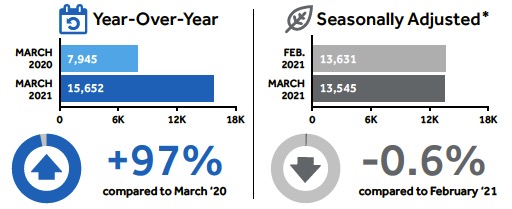
There were 15,652 sales in March 2021, up by 97% (almost double!) compared to 7,945 sales in March 2020.
Total Residential Sales
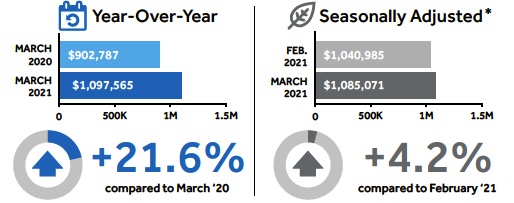
The average selling price in the GTA surpassed $1 million at $1,097,565.
Average Selling Price
Click below to watch the video highlights.

Housing Affordability
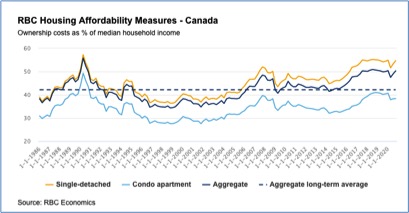
An economic paper by RBC Senior Economist Robert Hogue highlights the fact that home affordability (home ownership costs as a percent of household income) has gone down, as the prices have gone up.
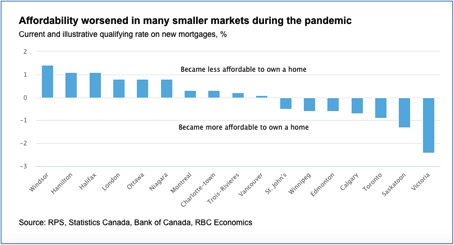
The measure for detached homes increased by 1.4% to 54.7%. The impact was felt across the country, however affordability worsened even more in smaller markets.
Housing Market Sentiment
Two recent research studies highlight Canadians’ confidence that the real estate market will continue to grow despite emerging, concerning signs of the market overheating:
First, a new survey by Nanos Research Group for Bloomberg News found that six in ten Canadians believe home prices will continue to rise over the next six months.
Second, a separate survey by BMO found that 62% of first-time buyers said they believe housing prices will continue to go up. The survey also found that sentiment around affordability has shifted with only 30% of millennials saying they felt optimistic about buying in the current market.
Real Estate Market Outlook
Home Sales
Last month, the Canadian Real Estate Association (CREA) revised its national home sales forecast for 2021. CREA expects 701,000 homes to sell in Canada this year–150,000 more than in 2020, the current annual home sales record-holder.
CREA’s previous forecast, released at the end of 2020, was for 583,600 homes to sell in Canada in 2021. With the past months of soaring sales activity, CREA felt the need to update its forecast for the year.
Home Prices
Last month, RBC Senior Economist Robert Hogue noted that the benchmark price of a Canadian single-family home has risen by $100,000 in the past six months, the sharpest increase in benchmark price of all time. While expecting the price appreciation trend to continue for the rest of 2021, Hogue noted that, “a creeping-up of longer-term interest rates, deteriorating affordability, the resumption of office work and possibly policy intervention will eventually cool homebuyer demand and set the stage for a soft landing.”
According to Scotiabank Economist Farah Omran, “We are likely to continue to see even further price gains in the months ahead.” Omran went on to say that the situation should change as the economy recovers from COVID and more housing supply becomes available.
TD Senior Economist Sri Thanabalasingam believes, “we are likely to see a significant cooldown over the next 2-3 quarters.” He expects policy interventions, affordability issues and ultimately mortgage rate increases to cool the price growth.
Benjamin Tal, Deputy Chief Economist at CIBC shared this when describing the current state of Toronto’s housing market, “If you think Toronto is unaffordable now, you wait.” Tal acknowledges that the current 20% year-over-year price growth is not sustainable, same as the other economists, however he points to continued population growth and lack of supply as driving long term housing price increases in the GTA.
Proposed Measures To Cool The Market
Amidst consumer optimism about continued home price growth, many financial leaders are calling for intervention to help cool the market and fend off a potentially ugly correction.
According to Robert Hogue, RBC Senior Economist, “the threat is particularly potent because excessively high price expectations are widespread.”
In a special report entitled “Canadian Housing Fire Needs a Response”, BMO Senior Economist Robert Kavcic and Director of Canadian Rates & Macro Strategist Benjamin Reitzes write: “The action needed today is one that immediately breaks market psychology and the belief that prices will only rise further.”
Derek Holt, Scotiabank Head of Capital Markets, thinks the Bank of Canada should have “changed their narrative” as the economy began to recover. “I have more of a bone to pick with the fact that they continue to guide heavily-indebted Canadians who are buying all these homes to believe that the cost of borrowing won’t increase for years to come.”
Some of the cooling measures being suggested include:
- First and foremost, increasing housing supply by easing the regulatory approval process for new housing, adjusting zoning guidelines to allow more “missing middle” homes, and building rental apartments.
- Discouraging speculative activity, for example by phasing out mortgage interest expense tax-deductibility for investors, or by increasing the capital gains tax rate on investment properties or by implementing a national non-resident tax.
- Having the Bank of Canada back away from the commitment not to raise rates until 2023 and gradually start to increase the overnight lending rate.
- Changing the real estate sales process to eliminate blind bidding and/or introduce standardized escalation clauses (as is the case in the U.S.)
- Increasing the mortgage stress test requirements for borrowers
RE/MAX has suggested a couple of practical real estate industry solutions:
- Make it mandatory that every offer include of purchase is conditional on financing.
- Institute an industry “watchdog” to review transactions where homes are sold well above asking price to ensure fair pricing practices.
Recently the Office of the Superintendent of Financial Institutions (OSFI) proposed increasing the mortgage stress test’s qualifying rate for uninsured mortgages to 5.25% rather than the current 4.79%. Some economists feel that, while a step in the right direction, this would not have a significant cooling effect. According to Stephen Brown of Capital Economics, “experience suggests that most buyers would not be affected.” Some of the other potential measures, such as a speculation tax or the elimination of blind bidding in real estate transactions would have a higher impact.
Selling a House During COVID
With COVID cases rising dramatically once again, I wanted to take a moment to reiterate the best practices for how realtors are to conduct business during the pandemic. The Ontario Real Estate Association (OREA) has published a guidance on Real Estate Transactions, with the main theme being that health and safety must come first. Here are the guidelines:
A. Digital Tools. REALTORS must continue to use digital tools such as virtual tours, virtual staging, video conferencing and electronic documents & signatures as much as possible.
B. Personal Protective Equipment. REALTORS must provide PPE for themselves and their clients for any in-person meetings.
C. In-Person Showings. REALTORS must continue to limit in-person showings as much as possible. If an in-person showing is necessary, REALTORS must follow all local health guidelines such as physical distancing, wearing PPE and cleaning/disinfecting both before and after the showing. During a showing, additional safety measures include:
- Having the homeowner away from the property
- Increasing ventilation by opening windows, if possible
- Making it quick
- Not touching anything
- Limiting the number of visitors to those on the contract only. No family members
- Having the home owner or listing realtor turn on the lights and open interior doors beforehand so the visitors don’t have to
- Not using the bathroom (actually, you should never use the bathroom at a showing)
Death Of The Asking Price
I read an interesting article on Storeys by Eric Wainwright questioning why realtors are wasting people’s time by setting unrealistic asking prices. He cited the numerous examples of properties selling for WAY more than the asking price – the headlines we read about every day. My favourite line from the article was, “Everyone knows you shouldn’t bring a knife to a gun flight. In Toronto, that somehow now seems to mean you shouldn’t show up to a million dollar listing without another half million in tow.”
I see this every day in my own real estate business; buyers who are attracted to a house they think is within their budget based on its asking price, only to be disappointed on offer night when it sells for 15 or 20% over asking with no conditions.
Some realtors are definitely pricing properties well below market value in order to create the conditions for a bidding war, but that isn’t always the case.
It is very difficult to put a fair price on a home right now. Homes we realtors think have a fair asking price go for way more and homes that have an exorbitant asking price actually achieve it.
For sellers, the thing to keep in mind is: you can’t under price a property. If you under price it, more potential buyers will see it and bid for it driving the price up to whatever market value happens to be at the time.
It is undoubtedly more difficult for buyers to navigate what is a fair asking price and what isn’t. In some cases, it might be best to adjust your budget. For example, if you know you can only spend $1 million and the majority of properties are selling for 15% over asking price, set your asking price threshold at $870,000. Your realtor will be able to help by providing information about past sales for similar properties in the same area.
Will Auctions Become the Way to Sell Homes?
With COVID occupancy limitations having an impact on sales centres and new construction launch events, one Ottawa-area home builder recently held an auction to sell three new homes.
Prospective bidders could choose from three detached models with the ability to customize the homes exterior and interior based on the builder’s list of décor upgrades. Floorplans, renderings, and detailed features were provided for each model, and a reserve bid (starting at $764,949) was established for each of them.
In order to be eligible to bid, participants were required to show proof of mortgage pre-approval.
Some industry experts believe that selling homes using an auction model is one good way of cooling down the market. The full transparency of offer prices would help buyers to avoid over-paying as some inevitably do in the current system of closed offers.
Help for Homeowners
As I write, Ontario is in the middle of a mandatory province-wide stay-at-home order in response to surging COVID cases and overloaded ICU’s. The order is in place until at least May 6, 2021. People are to leave their homes only for food, health-care, exercise or work that can’t be done from home.
Non-essential retail is closed to in-person shopping but can offer curb-side pick up or delivery. Big box retailers are open to in-person shopping but will only be allowed to sell essential items such as groceries, household cleaning supplies and pharmacy items. (This is good news for small businesses.) The essential stores that can remain open have capacity limitations.
Restaurants and bars are open for take out, drive thru and delivery.
Cinemas, concert venues and theatres are closed.
Outdoor activities, primarily for exercise and recreation, are allowed to continue with physical distancing.
For more information, click here.
Vaccination Rollout
Ontario is in Phase Two of the vaccine rollout.
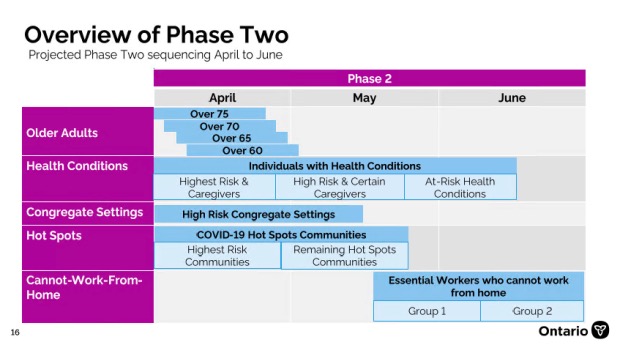
The information on what age groups are eligible to be vaccinated differs somewhat depending on where you live in the GTA. Here is the current eligibility criteria (as of April 12, 2021) by region:
Ontario-wide:
anyone 60 years of age and older using the provincial booking system
anyone 55 years of age at pharmacies and doctor’s offices
Toronto:
50 years of age or older in designated high risk neighbourhoods
York:
45 years of age or older in designated high risk neighbourhoods
Peel:
50 years of age or older
To book a vaccine:
Halton vaccine booking tool click here.
Peel vaccine booking tool click here.
Durham vaccine booking tool click here.
For all other regions, Ontario vaccine booking tool click here.
That’s it for this update. If you missed any of the past COVID-19 Impact on Real Estate updates you can find them on my blog here: http://stephhebbrealestate.blogspot.com/
There is also a ton of other information there about buying or selling real estate on the blog.
Please let me know if you have any questions or feedback at Stephanie.hebb@royallepage.ca.
Stay safe.
Steph
More reading:
https://www.livabl.com/2021/03/ottawa-builder-online-auction-new-detached-homes.html
https://www.livabl.com/2021/03/forecast-record-700000-homes-sell-canada-2021.html
https://www.livabl.com/2021/03/prices-soaring-canada-undersupplied-housing-market.html
https://www.livabl.com/2021/03/canadian-single-family-homes-gained-100k-value.html
https://www.livabl.com/2021/03/canada-overheated-housing-market-new-homes.html
https://www.livabl.com/2021/03/homebuying-frenzy-canada-housing-market-cooldown.html
https://storeys.com/toronto-real-estate-market-prices-benjamin-tal/
https://storeys.com/scotiabank-derek-holt-bank-of-canada-real-estate-prices/
https://storeys.com/remax-urges-caution-housing-market-cooling-measures/
https://storeys.com/toronto-real-estate-asking-price/
https://storeys.com/near-term-housing-outlook-grim-homebuyers-rbc/
https://storeys.com/canadian-housing-market-real-estate-national-concern-rbc/

Comments
Post a Comment