Emailed to Clients on August 10, 2020
Real Estate Market Overview A new sales record was set for the month of July! Traditionally a slower month for home sales, this July was different. As the GTA re-opened for business, pent-up demand from earlier in the Spring, combined with fewer families traveling for family vacations resulted in strong interest in housing. The number of new listings was up strongly, however they trended lower than the number of sales resulting in tightened market conditions. There were 11,081 sales in July 2020, up by 29.5% compared to July 2019 and up 49.5% compared to June 2020. This breaks the record for number of sales in July. Source: TRREB The average selling price was $943,710, up 16.9% versus year ago and up 5.5% compared to June 2020. 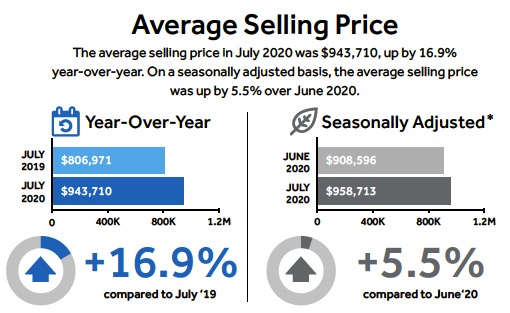 Source: TRREB There were 17,956 new listings in July 2020, which was up by 24.7% year-over-year. So who is buying homes when we’re in the middle of a pandemic? A pandemic that has caused an historic almost 14% unemployment rate and was expected to put downward pressure on real estate? In part the answer lies in the disparity of those whose jobs have been impacted. Many industry sectors have made a surprisingly successful switch to working from home using technology-based work solutions and have had little impact to their incomes. These tend to be office jobs in higher paying sectors such as finance, business, government and insurance. Confident in their job security and wanting to capitalize on low interest rates, these are the people making up the majority of the homebuyers – looking to either ‘trade up’ or ‘buy in’ to the market. While this isn’t the case across Canada, demand in the GTA is continuing to outpace housing supply resulting in stiff competition among buyers and price growth. 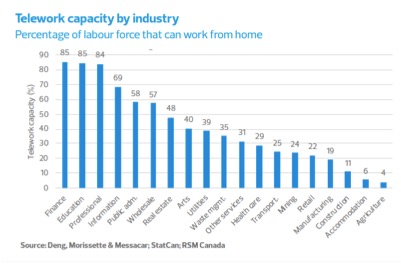 Real Estate Market Outlook The GTA real estate market has experienced three months of positive results with July breaking records. Even some economists seem surprised at how quickly the market rebounded. But while we might feel like the worst is over, let’s not forget that we are still in the early stages of this unpredictable pandemic. I recently attended a virtual conference with economists and guest speakers from across the real estate industry. They were all cautiously optimistic about the state of the GTA real estate market at the moment, but warned we have not yet seen the full impact of the pandemic. In particular, they expect that job losses and the lack of immigration, usually key drivers of demand, will be reflected in the results at some point. Here are some of the key take-aways from the conference. Consumer confidence is rebounding, but is (not surprisingly) still below pre-pandemic levels. July figures from the Bloomberg Nanos Canadian Confidence Index found that 59% of respondents believed the economy will worsen over the next six months and 16% said they feel “insecure or somewhat insecure” about their employment. 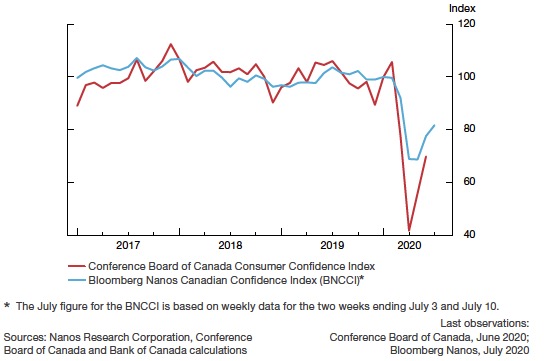 This is having an impact on consumer spending behavior with the Bank of Canada predicting the household saving rate to increase, and households expecting to spend less on non-essential things like travel, eating out and high-ticket durable goods. 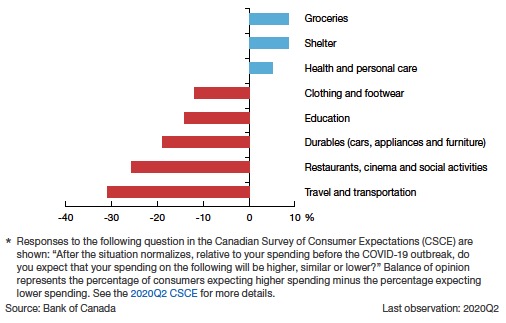 One might expect a greater emphasis on paying down debt. At 176%, Canada has one of the highest household debt-to-income ratios in the world. Perhaps this is the wake-up call needed to get people to address their debt. As long as household spending remains constrained there can be no meaningful economic growth. Job losses and job recovery will differ by region and sector. The unemployment rate is currently just over 12% in Canada. Not surprisingly, the shutdown of the economy affected different employment sectors differently, with those able to work from home less likely to suffer job losses. Employment losses have been greatest in sectors the least likely to be able to accommodate physical distancing such as accommodation, food service and storefront retail. While these businesses are starting to re-hire as they re-open, many are trying to manage with fewer staff to lower overhead costs. 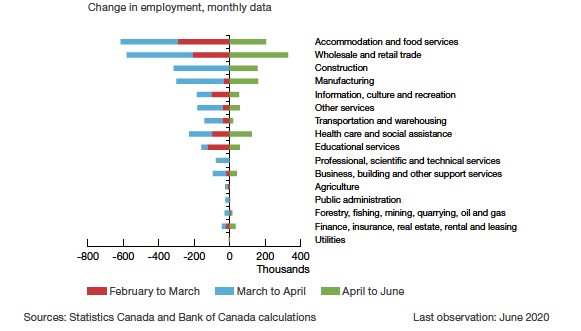 The impact on businesses will differ by sector as well. Most service sector businesses have been allowed to re-open, but with physical distancing requirements in place for the foreseeable future, many can only operate at partial capacity. With margins already exceedingly small for some businesses, restaurants for example, it remains to be seen if they can stay afloat. Further rounds of layoffs may occur as service sector businesses close for good. Now is a great time to “shop local/eat local” to help your neighbours’ businesses through this difficult time. The jury is out on whether or not there will be a mortgage debt-deferral ‘cliff’ or merely a ‘slope’ when the six-month time-frame is up for those who’ve received mortgage payment deferrals. Thirteen banks have granted more than 760,000 Canadians mortgage deferrals, most of which will be up this fall. Most experts agree that there needs to be more tools in place to help these customers or the time-frame should be extended. The CMHC has cautioned that as many as 20% of mortgage holders could default unless the economy rebounds quickly. Most economists think that the number of defaults will be far fewer than 20%. As we continue through the back half of 2020, both personal and business insolvencies are expected to increase. As their market goes, so goes ours. Although we have done a much better job of managing COVID-19 than the U.S., Canada’s economic outlook will be impacted by theirs nonetheless. The U.S. is our largest travel and tourism customer so the closed border already impacts our hospitality and convention industry. But beyond that, America is the largest consumer of Canadian manufacturing. We are enmeshed in U.S. supply chains and are therefore subject to the ripple effect of disruptions in the U.S. As our largest trading partner for products like oil, timber and livestock, we are inextricably tied to the U.S. In its continued “America First” stance, the Trump government has just announced a protectionist tariff on Canadian aluminum that will hurt exports. Ontario’s manufacturing sector is particularly vulnerable. All of this to say, the impact of COVID-19 may be far from over. There may well be tough times ahead that negatively impact on real estate. To quote RBC Global Asset Management Chief Economist Eric Lascelle, “But for all of this happy news, the final page has not yet been written on the housing market. As government support fades, delinquencies and foreclosures may rise, resulting in greater weakness later. Still, we only look for a modest decline rather than a steep drop.” Royal LePage is predicting annual growth of the Canadian housing market at 2.5%. According to CEO Phil Soper, “It’s about half the long-term rate of home price appreciation we’ve seen in Canada, so we’re not talking about a great year – but it’s far, far from the doom and gloom that some of those who are not as close to the market [as us] have prophesized.” Regarding real estate trends, the shutdown and working from home have impacted real estate preferences. Cottage country, rural municipalities and the outer suburbs have all experienced unusually strong real estate growth as people realize they can work from wherever as long as the internet connection is strong! Wanting to avoid the urban density thought to be responsible for community spread of the corona virus and perhaps be able to afford larger homes, some people are eschewing the city for small town living.  When to hold ‘em. One of the conference speakers raised a good point that I wanted to pass along. Basically real estate is a long game. If you’re planning to own your home for a number of years, most people can ride out any price deflation caused by the COVID-19 pandemic. The cohort that may have the most to lose are retirees. Let’s say that home prices drop later this year by 10%. A 10% hit on paper is one thing if you’re not planning to sell. If you’re planning to sell your home, downsize, and live on the difference that means a 10% hit to your retirement savings. If this is the scenario, retirees should try to wait to sell once the market has stabilized back in growth territory. Selling a Home During COVID-19.
Stage Three and Open Houses With the GTA finally in Stage 3 of reopening the economy, open houses are once again permitted, however both OREA (Ontario Real Estate Association) and TRREB (Toronto Region Real Estate Board) urge sellers and realtors to continue using virtual tours and safe showings, rather than open houses, as much as possible. When an open house is unavoidable, OREA recommends the following: - post a clear protocol outside the property for open house guests to read and follow.
- post signage asking people to self screen, a) if they’ve been ill, b) have symptoms of COVID-19, c) have been in contact with someone with COVID-19 or d) have travelled outside the country. If answering ‘yes’ to any of the questions, they should be asked not to enter the home.
- Set time limits for each group to give everyone a fair chance to see the home.
- Limit guests to two buyers and their realtor.
- Require masks.
- Manage traffic flow and physical distancing of those waiting outside.
- Provide hand sanitizer for each guest and sanitize and disinfect surfaces between each group.
- Enforce do not touch rules. Realtors, ideally wearing disposable gloves, should open doors and switch on lights so guests don’t have to.
It is further suggested that pre-registration be encouraged to manage numbers of guests and avoid crowds forming outside. Home Buyer Sentiment Despite the COVID-19 crisis the number of people expecting to buy their first home in the next year has doubled according to a report just released by Mortgage Professionals Canada. Both mid 2019 and at the end of 2019 only 7% of non-owners expected to buy a home in the next year – that number has now increased to 14%. When the same question was asked of owners, the number has remained relatively flat from 8% mid 2019 to 7% at the end of 2019 to 9% now. Among renters, the primary reason for wanting to buy is “I want to live in a nicer home” (28%), while the primary reason among homeowners is “my current home is no longer suitable” (38%). These results are likely a reflection of being shut down in one’s home for a length of time due to the pandemic. For many people working from home has highlighted the lack of space/privacy in their homes. For others, wanting to move from an apartment setting, where social distancing is difficult, could be a primary motivation. The fieldwork for the report was done between June 29 and July 13 and is based on a survey of 1,046 Canadians. |


Comments
Post a Comment