COVID-19 Impact on Real Estate - September 7, 2020
Emailed to Clients on September 7, 2020
Canadians Approve of Country’s Response to COVID-19
A recent study from the Pew Research Center found that almost ninety percent of Canadians polled say that the country has done well in dealing with COVID-19. 88% said Canada did a good job and 11% said the country did a bad job.
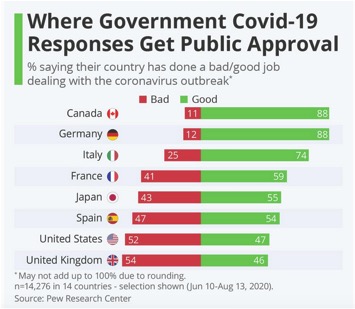
By comparison the results in the U.S. were much more divided with only 46% saying the U.S. did a good job and 54% saying the country did a bad job. Is this a surprise? Didn’t think so.
Real Estate Market Overview
August was another exceptionally strong month for real estate sales in the GTA. Buyers and sellers forced to sit on the sidelines in the Spring due to COVID-19 were very active in August. With demand outpacing supply, many properties sold for above the asking price with multiple offers driving the average price higher.
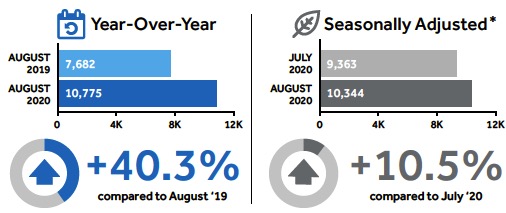
Instead of taking summer vacations this year, a number of families were buying and selling homes. There were 10,775 sales in August 2020, up by 40.3% compared to August 2019.
Total Residential Transactions
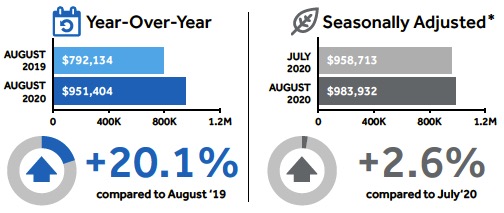
The average selling price was $951,404, up 20.1% versus year ago.
Average Selling Price
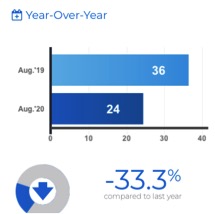
The increased demand is also reflected in the days on market data. The average days on market dropped from 36 days in August 2019 to 24 days in August 2020, a decline of 33.3%.
Property Days on Market
There were 18,491 new listings in August 2020, which was up by 56.8% year-over-year.
Total New Listings
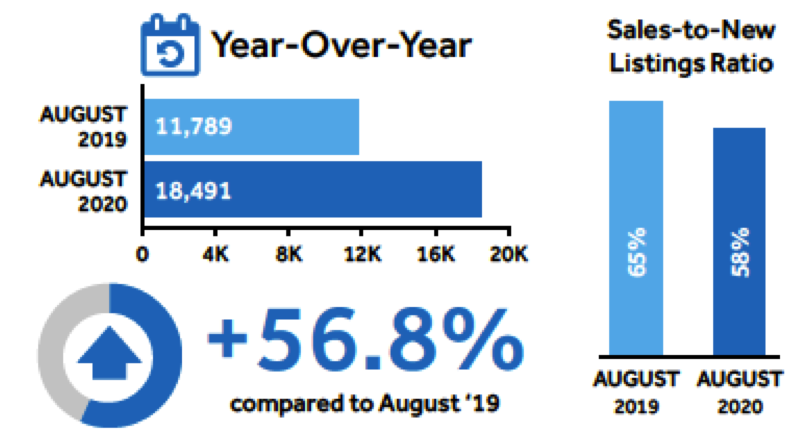
The ongoing demand for housing in the GTA presents a quandary for legislators. Past efforts, such as lowering borrowing costs and incentives for first-time home buyers, have focused on stimulating demand. Clearly there is no shortage of demand! The GTA needs housing supply and FAST! This will require legislators to amend their approach and foster housing supply programs. In June, BILD (the Building Industry and Land Development Association) provided the Ontario government with a 20-point plan to stimulate economic growth and job creation and fuel home building by relieving some of the financial burdens for investors. Hopefully some of their recommendations are adopted and help to fill the void in affordable housing.
Real Estate Market Outlook
From my Soapbox
As many of you know, I am relatively new to real estate sales. My second career began when I got my real estate license in 2014. Before that I spent over two decades working with clients in marketing in a trusted, respectful and collaborative environment.
When I started in this business, I was shocked by the lack of trust people have in realtors. Sure, I have come across a few bad apples, but the majority of real estate agents are honest, hardworking people whose reputations are being tarnished by the dishonest few.
I came across an article in the Real Estate Magazine that really brought this into perspective. In the article entitled “Are Real Estate Prices About To Drop?” the author made a number of derogatory comments about realtors such as “there are some dishonest real estate agents that are wanting to promote that the market is doing well” and “people should not get their market information from real estate agents.” The pièce de résistance was this comment: “if the sky were falling and zombies were walking around Vancouver, some Realtors would still say it’s a great time to get into the market.” Funny, yes, but also unfair to so many earnest and honest realtors.
Even the CEO of Canada Mortgage and Housing Corp seems to suggest that Realtors aren’t to be trusted.
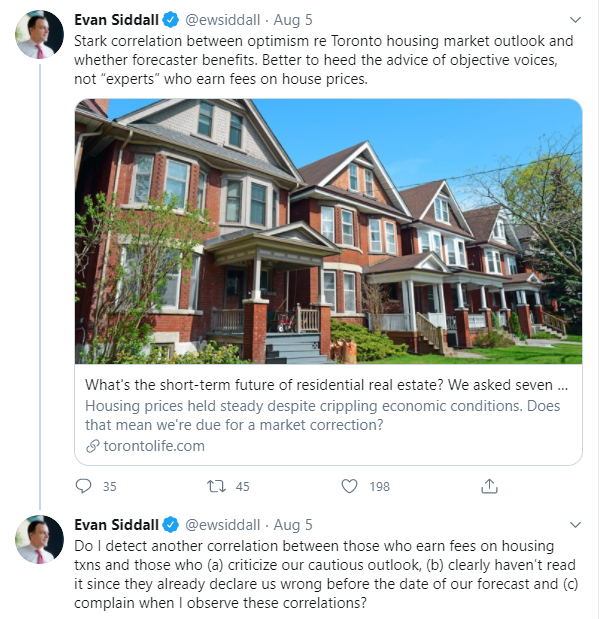
Realtors and real estate associations are trying very hard to set a standard for both job performance and integrity in the profession. While, inevitably, there is no perfect system for identifying the few out for a quick buck, I hope you will make sure to use a qualified, licensed professional as your real estate partner and give them the benefit of the doubt unless you have reason not to.
If you’ve been reading these COVID-19 newsletters of mine consistently, I think you’ll agree that my approach to the market has been cautious at best. I’ve tried to highlight both positive and more pessimistic outlooks.
The Jury is Still Out on the Outlook
RE/MAX recently released their Fall 2020 Outlook. They revised their forecast upwards predicting average Canadian home prices to rise 4.6 percent by the end of 2020, up from the 3.7% increase predicted in their last release.
According to RBC Senior Economist, Robert Hogue, “We expect the market’s vigour to continue in August and perhaps September. We believe there’s still some pent-up demand left to satisfy.” However, he went on to say “We expect the phasing out of CERB and other financial support programs, high unemployment and lower immigration to cool housing demand later this year.”
TD’s Brian DePratto said “while the strength of the recent rebound is definitely surprising (there remains a significant degree of uncertainty surrounding the economic outlook), there are clearly near-term push factors supporting housing.” He went on to say “It is however, important not to extrapolate recent gains too far. A number of support programs including mortgage forbearance, are helping insulate the economy from the worst impacts of the pandemic. As autumn approaches, these programs will expire or change form. Depending on the progress of the broader economic recovery, this could bring significant headwinds to housing markets, particularly prices.”
A Quarter of Mortgage Holders Expect Some Difficulty Making Payments
In a report released by Mortgage Professionals Canada, over a quarter of mortgage holders said they expect to have difficulty making payments. 23% said they expected “some” difficulty, while 5% said they expected “a high degree” of difficulty.
This may be a sign that some mortgage defaults are on the horizon as the CMHC has predicted.
Help for Homeowners
Changes to Financial Support for Individuals
On August 20, the federal government announced the next phase of support to aid Canadians in the recovery from COVID-19.
The CERB (Canada Emergency Response Benefit) is being extended by an additional four weeks to a maximum of 28 weeks.
The Employment Insurance program is being expanded to include some Canadians who have not qualified in the past and providing at least $400 a week as a taxable benefit.
Three new benefits are being implemented:
- The CRB (Canadian Recovery Benefit) will provide $400 a week for up to 26 weeks for self employed workers or those not eligible for EI whose income has dropped due to COVID-19.
- The CRCB (Canada Recovery Caregiving Benefit) will provide $500 a week for up to 26 weeks for those unable to work while caring for children due to schools and daycare closures, disabled or dependent family members due to program or care facility closures or disabled or dependent family members not attending programming due to being at high risk should they catch COVID-19 as advised by a doctor.
- The CRSB (Canada Recovery Sickness Benefit) will provide $500 a week for two weeks for workers sick or self-isolating due to COVID-19.
COVID Alert Mobile App launched
On July 31, Prime Minister Justin Trudeau and Ontario Premier Doug Ford launched the Canada COVID Alert App to help warn people who may have been exposed to a case of coronavirus.
The app uses Bluetooth technology to ping nearby phones. If the devices are within two metres of each other for more than 15 minutes, the encounter is noted, to be used later in case one of the device owners tests positive.
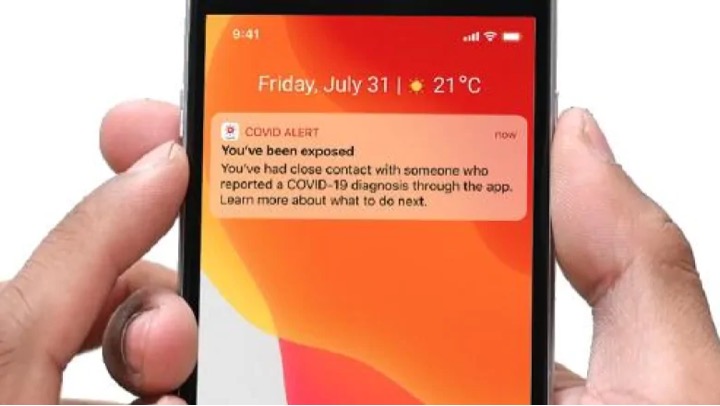
When a person tests positive, they are given a code to enter into the app, which then notifies those who’ve been exposed to them. The positive person’s identity is never revealed by the app, just that they’ve been in contact “with someone” who’s tested positive.
The app is a great idea in theory. In practicality there are a few flaws.
- The app has to be on your device recording your encounters for two weeks BEFORE a positive COVID-19 diagnosis or it doesn’t do anyone any good. Said another way, if you get tested and find out you have COVID-19 downloading the app at that point won’t help because it can’t retroactively track who you’ve been in contact with.
- The app relies on the individual with the positive test to input their own test result. Here’s the problem. The app has been downloaded 2.2 million times. Since the launch 80-100 people per day have tested positive for COVID-19 in Ontario, but only 90 people in total have logged their positive result in the app. Not sure why people aren’t using the app in the way it was intended – embarrassment? Fear? Or maybe they are just too busy being sick. It might be a better idea to have the results load onto the app by the testing facility, so the onus isn’t on the individual to (maybe) do it.
- It is only available in part of the country. Ontario, and now Newfoundland have rolled out the app.
- There are misconceptions about the technology that are impeding more widespread use of the app. For example, people are concerned about their privacy. The app is intended to be anonymous. It doesn’t track people’s location or attempt to identify them. The Bluetooth technology isn’t location-based, it is proximity-based so the app doesn’t know where you are, just what other devices you’ve been near. Convincing people to believe this may be a challenge.
Although imperfect, the app is best thing we have at the moment and the sooner you get it, the better it works for everyone. Let’s all download it to our devices. You can find more information here.
Can You Get COVID-19 From Your Groceries?
I don’t know about you, but I’ve been spending an inordinate amount of time disinfecting the groceries I bring home. Since I try to do a week’s worth of shopping at once, the disinfecting and putting away can take over an hour. It’s no surprise this article from the BBC caught my eye.
Basically the article quotes a Rutgers University microbiologist who thinks the chances of catching coronavirus from surfaces, such as food packaging, is very small. He points out flaws in the studies that show the virus can survive for hours on certain kinds of packaging material, saying the concentration of virus used in the laboratory studies is much, much higher than would be found in the real world. He also points to more recent studies which conclude that the virus is thought to spread person to person between people in close contact when an infected person coughs, sneezes or otherwise spreads airbourne viral particles, and the other person inhales them.
According to the World Health Organization “there is currently no confirmed case of COVID-19 transmitted through food or food packaging.” WHO says there is no need to disinfect food packaging, but “hands should be properly washed after handling food packages and before eating.”
Once again, hand sanitizer and hand washing are your best friends. I think I may relax my grocery disinfection policy after reading this. What do you think?
That’s it for this update. If you missed any of the past COVID-19 Impact on Real Estate updates you can find them on my blog here: http://stephhebbrealestate.blogspot.com/
There is also a ton of other information there about buying or selling real estate on the blog.
Please let me know if you have any questions or feedback at Stephanie.hebb@royallepage.ca.
Stay safe.
Steph
More reading:
https://www.livabl.com/2020/06/homebuilders-covid-economic-recovery-roadmap-province.html
https://www.livabl.com/2020/08/supercharged-housing-market-last-through-september.html
https://economics.td.com/ca-existing-home-sales
https://www.livabl.com/2020/08/remax-home-price-projections-market-rebounds.html
https://www.remonline.com/are-real-estate-prices-about-to-drop/
https://www.livabl.com/2020/08/28-canadians-believe-difficulty-mortgage-payments.html


Comments
Post a Comment