COVID-19 Impact on Real Estate - October 13, 2020
Emailed to Clients on October 13, 2020
Here’s this month’s update:
Real Estate Market Overview
September was another record-breaking month for real estate sales in the Greater Toronto Area. In fact, third quarter as a whole was record-breaking, helping to offset weakness in April/May and leading to an increase of 1% year-to-date compared to the first nine months of 2019.
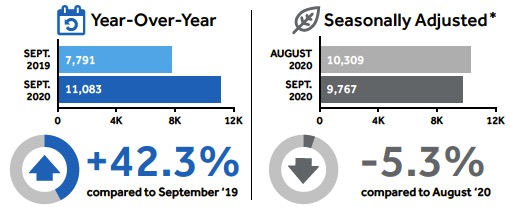
There were 11,083 sales in September 2020, up by 42.3% compared to September 2019.
Total Residential Transactions
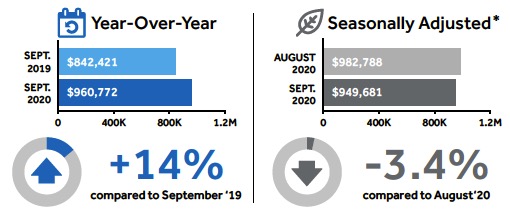
The average selling price was $960,772, up 14% versus year ago and a new record price for September.The average selling price was $951,404, up 20.1% versus year ago.
Average Selling Price
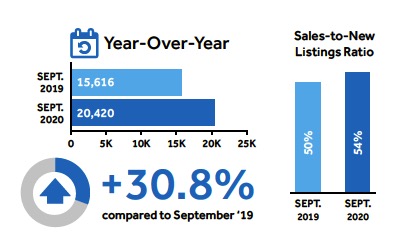
Sales in September continued to outpace new listings leading to competition between buyers driving prices up.
Total New Listings
Market growth is being driven by ground-level housing including detached, semi-detached houses and townhouses. With more available condo supply (for all the reasons we’ve discussed previously such as the Airbnb property dump and investors moving out of rental housing as rents drop) condo apartments experienced slower growth.
Real Estate Market Outlook
As will come as no surprise, there continues to be a disparity of opinions on the future of the Canadian real estate market.
Leading things off, the CMHC (which has come under fire for “fear mongering” by some analysts) said this month that they stand by their earlier prediction that Canadian home prices will drop between 9 and 18%. CMHC Chief Economist Bob Dugan said, “I’m not convinced that we have a sustainable basis for housing demand in the economic disturbance that’s going on related to COVID-19, That’s why I say I stand by the forecasts.”
Moody’s Analytics released a report forecasting the average single-family detached house price to fall by 6.7% in 2021. According to the author of the study, Abhilasha Singh, “High unemployment and lower income will restrain buyers’ return to the market. So will affordability issues in Vancouver and Toronto. Further, slower in-migration flows to Canada due to COVID-19 disruptions will weigh on housing demand. Not even lower interest rates will be enough to save the housing market.”
Following a summer of frenetic buying activity that seemed immune to COVID-19, the Canadian housing market appears to be slowing. CREA (Canadian Real Estate Association) Senior Economist Shaun Cathcart had this to say, “Despite some record monthly highs and lows this year, with eight months now in the books and activity showing signs of moderating in September, 2020 is looking like it will go down as a fairly middling year overall – weaker than in a non-COVID world but quite a bit better than we would have given it back in April.”
Economists from three major Banks all agree that the pent-up demand that has fueled the hot market is now largely satisfied. TD Senior Economist Brian DePratto said, “as of August, the level of sales activity is now in line with historic norms, suggesting that much of this pent up demand has been satisfied.” BMO Senior Economist Robert Kavcic wrote that pent-up demand has likely run its course, noting that some Canadian housing markets are expected to stay hot while others will cool this fall. RBC Senior Economist Robert Hogue wrote, “The pandemic completely disrupted normal seasonal patterns by shifting activity from the spring to summer. With pent-up demand now largely exhausted, we see activity cooling later this fall. This should let some of the steam out of prices though not to the point of causing outright declines on a large scale.”
Toronto Real Estate Market
Regarding the Toronto market in particular, signs are emerging that support that the market is vulnerable to overheating.
The CMHC just released a report from second quarter 2020 (keep in mind it doesn’t capture the record setting months of July and August) that shows Toronto is one of seven Canadian markets showing “moderate” vulnerability and an increase in overvaluation.
Global bank UBS recently announced that Toronto is the only North American city at high risk of being in a bubble. Toronto ranked third globally behind German cities Munich and Frankfurt and ahead of Hong Kong, Amsterdam and Paris.
L, U, V, W…. or is it K?
Letter shapes are often used to describe economic recovery patterns. Earlier in the year, economists debated which shape the Canadian post-COVID recovery would most resemble. They were hoping for a V – meaning the economy would shoot straight back up to pre-pandemic levels, and dreading an L – where the economy would take some time to recover.
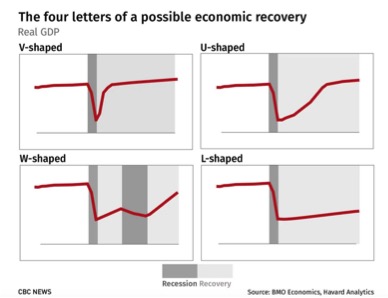
But what may be emerging is what’s being referred to as K. K means there are two paths – one goes up, while the other goes down. COVID-19 has certainly impacted different groups differently. One group was able to shift to working from home relatively easily, and their income has remained steady. This group includes office workers, management and administrators as well as those who’ve benefited from COVID, such as anyone in online retail or home delivery. These are the folks able to benefit from low interest rates and who are driving growth of the housing market.
The downward path of the K reflects those whose jobs have been affected by COVID-19, such as retail, hospitality and food-service workers, as well as small business owners. These folks are being hit hard. A recent statistic from the Mississauga Food Bank was that they’ve seen an increase in new food bank users of 138% compared to last year. Government policy makers need to pay attention to these Canadians to aid in economic recovery.
Selling a House During COVID
You may recall that last month I vented a bit about there being ‘bad apples’ among realtors. A recent news story really highlighted one of the ‘bad apples.”
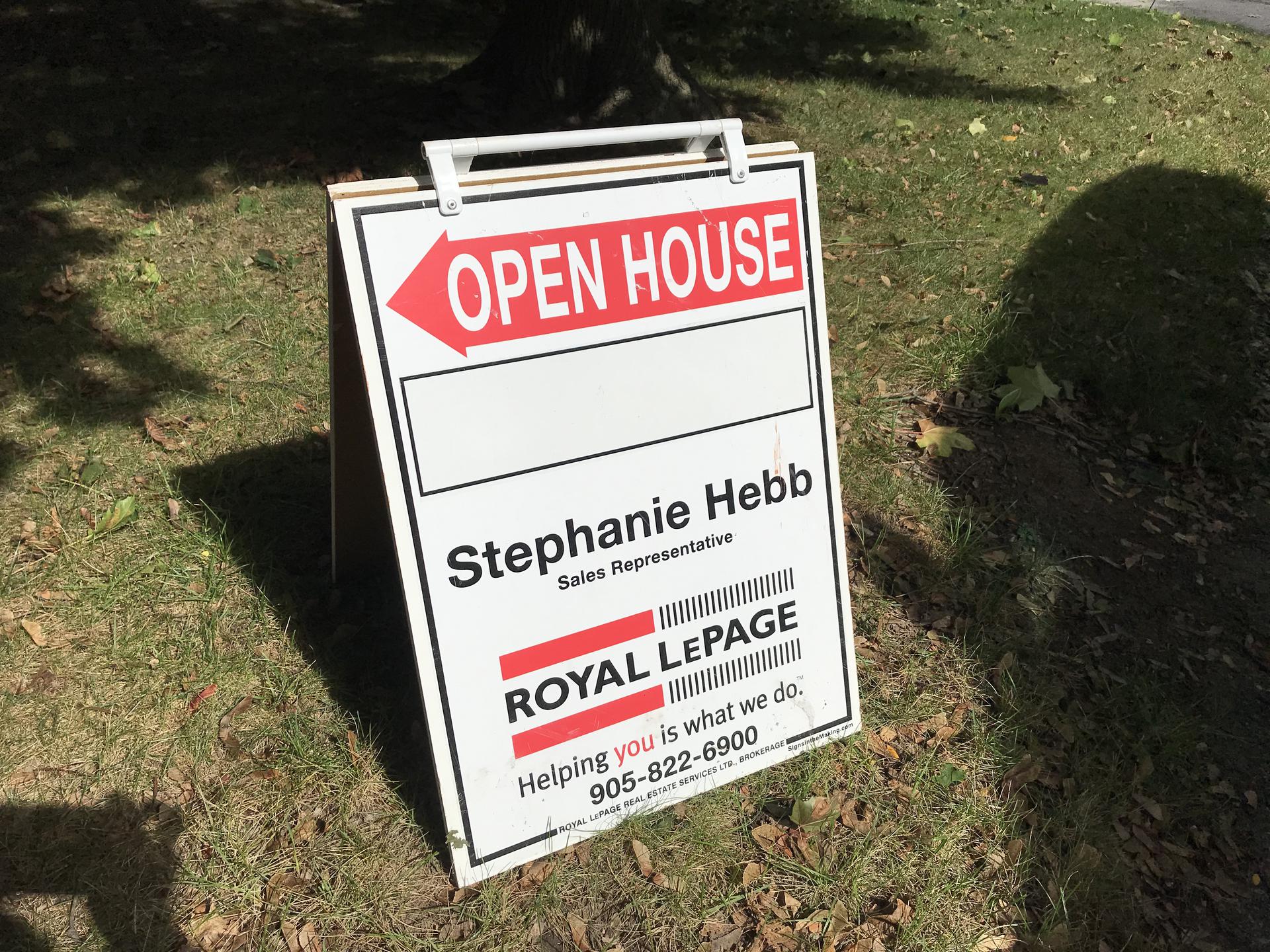
On a Saturday in mid-September, a Toronto realtor held an open house at a downtown property for sale. Open house visitors were asked to wear masks and physically distance as they viewed the home. On the second floor of the home one of the bedrooms had a sign on the door saying “Sorry, I’m sick.” It turned out that the tenant in that room was later confirmed to have COVID-19. If it wasn’t bad enough to go ahead and host an open house at a property with someone sick, this is what I find to be even worse: the sick tenant was moved to a hotel later that day so they could have another open house on Sunday! And the realtor admitted to CTV News that they did no extra cleaning or sanitization prior to opening the house up to visitors the following day.
This is clearly unacceptable behavior and has been widely condemned by public health authorities and real estate organizations. To quote from TRREB’s (Toronto Regional Real Estate Board’s) Open House Guidance During Stage 3 of Reopening: “You are obligated to refuse entry to the consumer, [and] reschedule if the seller or tenant is displaying symptoms.”
10 Best Practices for Open Houses
Prior to the GTA moving to Stage 3 of Reopening in July, TRREB published the Open House Guidance During Stage 3 of Reopening to inform realtors of the expectations of them. The document clearly states that “it’s not business as usual” and that, although no longer prohibited, “in-person open houses should be used as a last resort.” It goes on the list 10 Best Practices as follows:
- Consider Your Clients’ Best Interests by assessing risks before deciding to do an open house.
- Understand the Safety Protocols to Follow particularly as they evolve.
- Leverage Technology to Reduce In-Person Interactions for example having virtual open houses and using digital marketing tools.
- Use Your Professional Judgement and be prepared to change plans if anyone is displaying symptoms.
- Anticipate and Respond to Community Concerns if members of the public complain about there being an open house.
- Limit Attendance and Manage Consumer Expectations by pre-qualifying visitors and ensuring they have exhausted all virtual means of touring the property.
- Plan in Advance to have PPE, cleaning supplies, hand sanitizer and signage outlining the COVID-19 protocols in place. Manage open house traffic to optimize physical distancing.
- Keep Safety in Mind During the Open House and Limit the Number of People. Follow the COVID-19 safety protocols and keep a list of attendees for contact tracing.
- Consider the Requirements of Multi-Tenanted Properties where common areas and elevators are sharing by building occupants and respect their safety protocols.
- Safely Conclude the Open House and recommend that sellers clean and disinfect their homes upon their return.
Help for Homeowners
OREA On Ways Housing Can Help The Post-COVID Recovery
On September 21, 2020, OREA (Ontario Real Estate Association) released a policy report entitled Rebuilding Ontario:A Framework for Recovery outlining suggestions that would help housing aid in Ontario’s post-COVID economic recovery. OREA CEO Tim Hudak said, “The aftermath of the COVID-19 pandemic reminds us how important the housing sector is to Ontario’s economic health…Ontarians continue to tell us that buying a home is a good investment; Ontarians want to be homeowners, and the health of our economy depends on their ability to be homeowners…Real estate saved our economy during the last downturn and it can once again be the locomotive that gets us back on track, stimulates the economy, and gets Ontario back to work.”
The report outlines 15 recommendations for policy-makers’ consideration, including introducing a Home Renovation Tax Credit (a strategy that helped rebuild Ontario after the last recession) and changes to the Land Transfer Tax (LTT) to aid in home affordability. The report suggests implementing a short-term LTT holiday to boost market activity, permanently increasing the LTT break for first-time home buyers and making permanent changes to the LTT calculation to benefit all buyers.
You can view the entire report here.
Unwise Decisions in the Fight Against COVID-19 (IMHO)
There have been three recent government announcements that I feel are NOT helpful as Ontarians fight against COVID-19.
1. Self-Isolation Rules for School Employees
As of September 21, teachers and school staff will be required to work even if they have been in close contact with a person showing symptoms of COVID-19. In other words, if a family member of a teacher is showing is exhibiting COVID symptoms, but they haven’t received confirmation that they have the disease yet, the teacher must either go to work, potentially carrying and spreading COVID themselves or use a sick day or unpaid day in order to stay home. This is a change. Previously school staff and teachers were told to self-isolate and stay home from work if they had close contact with a probable case of COVID without having to use an unpaid day. Clearly this change in policy for school staff is financially driven and not in the best interest of students’ health.
2. Toronto Public Health Suspends Contact Tracing
On Friday, October 2, Toronto Public Health made a significant shift – they will no longer call the contacts of someone testing positive for COVID-19 to warn them to self-isolate and get tested. The reason behind the decision is clear, they simply don’t have the resources to do the contact tracing quickly enough to actually have it make a meaningful difference. If, because of a backlog of calls, its takes them days to reach someone whose been exposed, that person has already been out in public for days potentially spreading the virus. While Toronto Public Health was able to manage this quite well during the summer, the a) steep increase in cases, and b) steep increase in the number of contacts each patient has (due to people not limiting their contacts they way we’ve been asked to) has made it too difficult to do in a timely manner. Toronto Public Health has called on the Ontario government to take immediate steps to tamp down the spread. Once case counts have flattened, Toronto Public Health hopes to be able to return to contact tracing.
3. Testing by Appointment Only
As of October 6, people must have an appointment to get tested for COVID-19 in Ontario, and the Ontario government is urging those not showing any symptoms to not get tested. Despite rolling out testing to pharmacies and increasing overall testing capacity, the province is experiencing a huge backlog of tests. The problem with appointment-based testing is that people can’t and won’t self isolate while they wait days for a test and then again while they wait for the result. They will have to go to work. They will have to get groceries. They will have to interact with others. The ability to be tested quickly and get a quick result is crucial to stopping the spread of the virus.
That’s it for this update. If you missed any of the past COVID-19 Impact on Real Estate updates you can find them on my blog here: http://stephhebbrealestate.blogspot.com/
There is also a ton of other information about buying or selling real estate on the blog.
Please let me know if you have any questions or feedback at Stephanie.hebb@royallepage.ca.
Stay safe.
Steph
More reading:
https://www.livabl.com/2020/09/canada-housing-recovery-slowing-down-september.html
https://thoughtleadership.rbc.com/canadas-housing-market-reached-new-heights-in-august/


Comments
Post a Comment