COVID 19 Impact on Real Estate - November 11, 2020
Emailed to Clients on November 11, 2020
Real Estate Market Overview
October was another record-breaking month for real estate sales in the Greater Toronto Area.
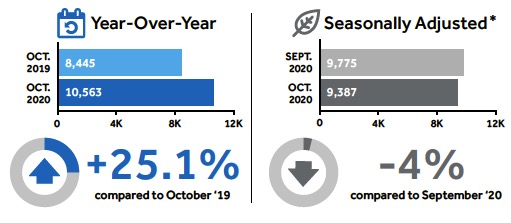
There were 10,563 sales in October 2020, up by 25.1% compared to 8,445 sales in October 2019.
Total Residential Sales
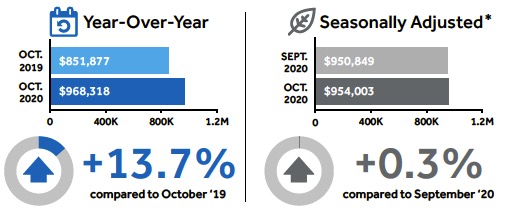
The average selling price was $968,318, up 13.7% versus $851,877 in October 2019.
Average Selling Price
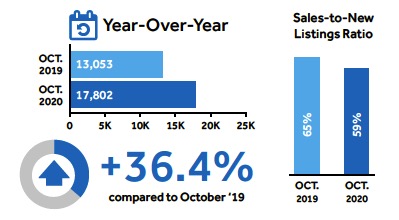
New listings reached record levels for the month of October, up 36.4% compared to last year.
Sales to New Listing Ratio
There continues to be a disparity between detached housing, where the pace of sales growth far exceeded growth in new listings, and the condo apartment segment.
In the detached segment, active listings fell by 30% while sales rose by 34% compared to October 2019. In the Toronto (416) condo segment, active listings rose by 173% and sales declined by 8.5% compared to last year (more on this in the next section).
Real Estate Market Outlook
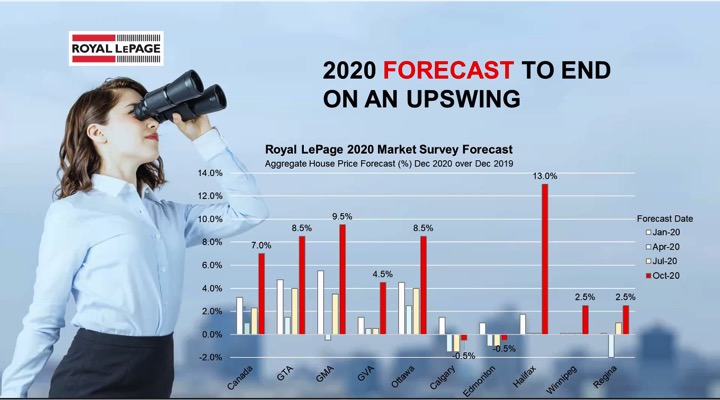
Royal LePage released our home price forecast on October 14th, 2020. According to the Royal LePage House Price Survey and Market Survey Forecast, the aggregate price of a home in Canada rose by 8.6% in the third quarter compared to last year.
Royal LePage is forecasting the national aggregate home price will increase by 7% in the fourth quarter.
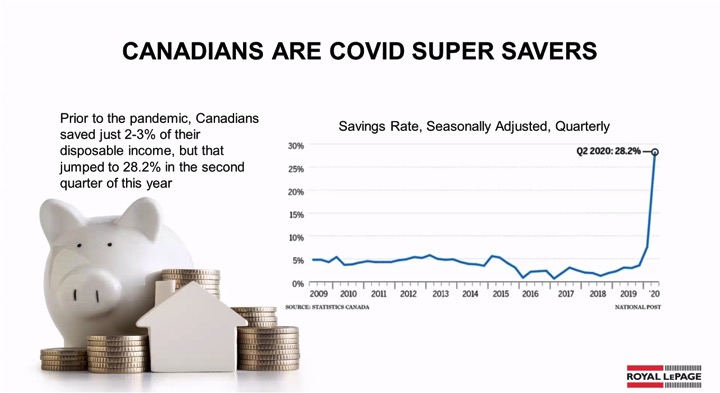
Royal LePage President and CEO, Phil Soper, points to the fact that the pandemic impacted people’s discretionary spending patterns, leading to drastically increased savings that they were able to divert to housing, taking advantage of low mortgage rates.
CIBC Deputy Chief Economist, Benjamin Tal is calling this “the most housing-friendly-recession ever” while warning that the economic indicators are pointing to a cooling of the market.
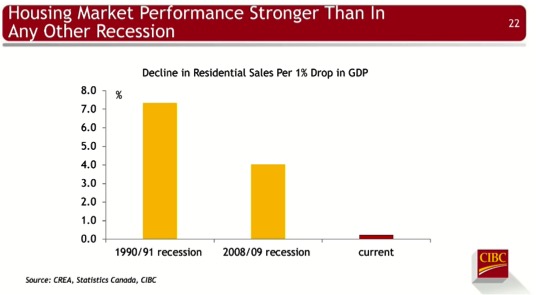
Citing the inequity of the impact of COVID on job sectors (see last month’s article about the K-shaped recovery), Tal believes that the impressive sales and price growth so far this year has been driven by those whose incomes have not been impacted by COVID thus far.
Tal predicts that the second wave of the virus will begin to impact more jobs and, by extension, the housing market. Tal writes: “We therefore expect sales to stabilize at a level below their long-term potential, while home price inflation will moderate notably, and, in fact, might fall into negative territory as we approach the winter months.”
What’s happening in the Condo Segment?
Despite strong market growth overall in the GTA, the one segment experiencing weakness is condo apartments in the 416. Here are the reasons for the relatively poor performance.
Demand for condo rentals in Toronto ‘proper’ took a hit due to COVID-19. Job losses meant that more would-be renters either moved in with relatives or to larger properties with roommates. Closed international borders kept foreign students and new immigrants out of the country.
As rental supply flooded the market, the average monthly rent for a condo in Toronto declined by 9.4% annually to $2,249 in the third quarter.
By the end of the third quarter there were 9,154 active condo rental listings, roughly 4 times the number as this time last year.
Diminishing rental returns have prompted many investor-owners to list their Toronto condos for sale. This, combined with the number of short-term (Airbnb) rental properties also on the market, has caused the 173% increase in available condo listings and flat (0.8%) price growth on an annual basis.
Complicating the situation even further, new condo construction is happening at near record levels. 5,411 new condo units are to be completed in the fourth quarter of 2020 adding to the supply and making resale units less attractive to buyers.
One piece of good news: Outside of Toronto in the ‘905’, condo sales remained brisk in October, with sales growing by 28% and prices up 7% versus last year.
Immigration Changes Will Help
On October 30th, the Federal government updated Canada’s immigration targets between 2021 and 2023 to help make up the shortfall from the pandemic.
In the second quarter of this year, the number of new permanent residents dropped by 64% causing total net migration to drop by 94%. This loss in immigration has both short-term and long-term implications for housing. In the short term, new Canadians often rent so the reduced number of immigrants has negatively impacted the rental market. On average, most immigrants are able to buy a home three years after arriving in Canada – this means the long-term effect of fewer immigrants would be felt three years from now.
The new immigration targets aim to make up the shortfall by increasing yearly targets by 50,000 for the next three years.
Selling a House During COVID
Open Houses Banned Again
As the second wave of COVID-19 spikes, the Ontario government once again moved to Stage Two of Re-opening, including a ban on real estate open houses starting October 17th.
Open houses were previously banned in Ontario from early April to late July during the pandemic’s first wave.
Help for Homeowners
OREA Recommendations Adopted In 2020 Ontario Budget
On November 5th, the 2020 Ontario Budget was released. The province adopted two of the recommendations made by OREA (Ontario Real Estate Association) in their proposal entitled Rebuilding Ontario: A framework for recovery. Specifically, the province will create a one-year Home Seniors Safety Tax Credit (HSSTC) to help seniors renovate their homes to allow for safely aging in place, and will reduce the Business Education Tax for commercial and industrial businesses.
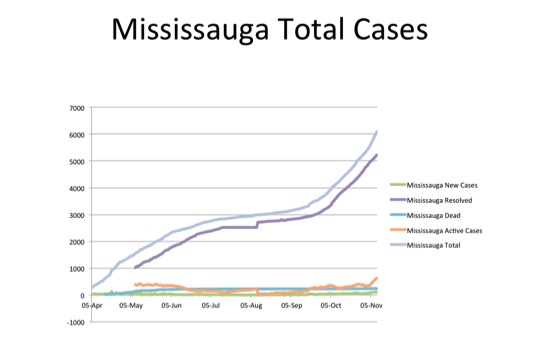
Cases of COVID-19 in Mississauga
New Framework For Keeping Ontario Safe And Open
On November 3rd, the Ford government announced a new tiered system intended to mitigate the spread of COVID-19 while giving businesses the opportunity to remain open as much as possible. The framework outlines the following priorities:
- Limit the transmission of COVID-19
- Avoid business closures
- Keep schools and childcare open
- Maintain healthcare and public health system capacity
- Protect vulnerable populations
- Provide additional supports where possible
The framework identifies five key risk factors for the spread of COVID-19: close contact, closed spaces, crowded places, prolonged exposure and forceful exhalation.
There are five coloured tiers in the framework from the lowest level of measures, “Prevent”, to the level of maximum measures or “Lockdown.” Here is a chart explaining the tiers.
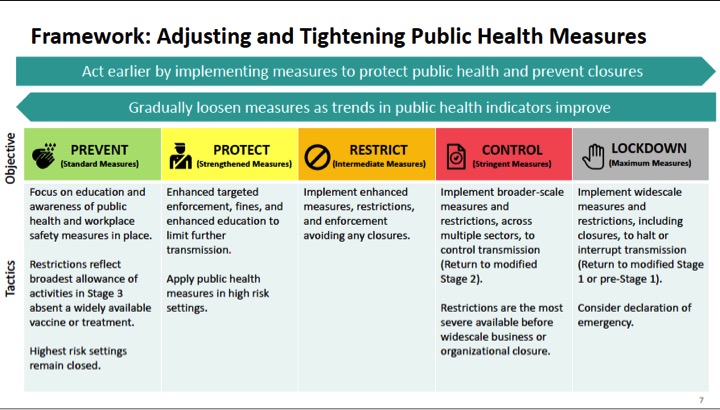
For each tier the framework identifies indicators such as incidence rates, positivity rates, hospital and ICU capacity, and public health contact-tracing capacity, that will be used to determine whether a region will move up or down a tier.
A number of types of businesses, including restaurants, gyms and personal care facilities have additional restrictions placed on them to allow them to operate safely.
The Ontario government put Peel Region in the Red “Control” zone, the second-to-highest tier of the framework.
You can view the entire framework here.
Additional Restrictions In Peel
Here in Peel Region, our Medical Officer of Health, Dr. Lawrence Loh, went one step further. On November 7th, Dr. Loh issued additional directives to help stop the spread of COVID-19.
- Social gatherings celebrating holidays and life events are not allowed in business establishments
- Wedding receptions and associated gatherings are not allowed
- Religious services are to be virtual. When not possible, indoor capacity is to be restricted to 30% capacity up to a maximum of 50 people with households seated together 2 metres from other groups
- Bars and restaurants can only seat households together
- Workplaces are to prevent non-essential visitors and allow employees to work from home as much as possible
- Gyms and fitness centres can only allow pre-registered participants
- Meetings and events spaces to close
- Residents must only have contact with household and essential supports
- No visiting other households except in an emergency
Dr. Loh introduced these measures as a response to high case counts of COVID-19, high positivity rates and hospitals and ICU’s in the Region of Peel at the point of capacity. The measures are to be re-evaluated every two weeks.
That’s it for this update. If you missed any of the past COVID-19 Impact on Real Estate updates you can find them on my blog here.
There is also a ton of other information there about buying or selling real estate on the blog.
Please let me know if you have any questions or feedback at Stephanie.hebb@royallepage.ca.
Stay safe.
Steph
More reading:
https://www.livabl.com/2020/11/toronto-condo-prices-weakening-listings-skyrocket.html
https://www.livabl.com/2020/10/immigration-unemployment-investors-challenges-housing-market.html
https://www.livabl.com/2020/10/toronto-condo-rents-fall-record-market-activity.html
https://economics.cibccm.com/economicsweb/cds?ID=11610&TYPE=EC_PDF


Comments
Post a Comment