COVID-19 Impact on Real Estate - January 12, 2021
Emailed to clients on January 12, 2021
Here’s this month’s update:
Real Estate Market Overview
December was another record-breaking month for real estate sales in the Greater Toronto Area, capping off the third-best year on record with 95,151 sales. 2020 sales were up 8.4% compared to 2019 despite a slow second quarter due to the impact of COVID-19.
There were 7,180 sales in December 2020, up by 64.5% compared to 4,364 sales in December 2019.
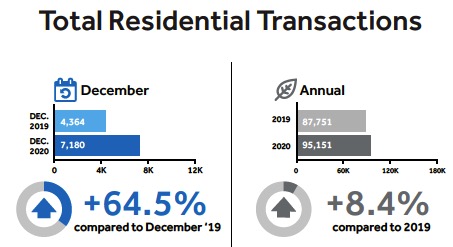
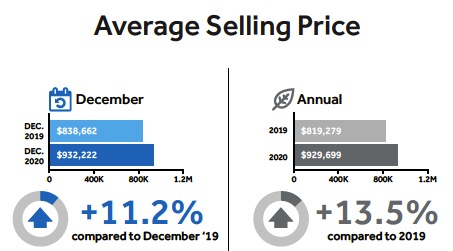
The average selling price in 2020 set a new record of $929,699 up by 13.5% compared to 2019. The average selling price in December was $932,222, up 11.2% versus $838,662 in December 2019.
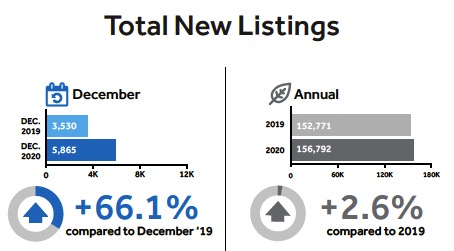
New listings in December were up 66.1%, from 3,530 in 2019 to 5,865 in 2020.
While the GTA housing market as a whole rebounded after a softer than normal spring, there was a disparity between the results for single-family homes and condo apartments. Generally, condo inventory outpaced demand, lending bargaining power for those in the market for a condo and a softening of sale prices as a result.
6 Ways COVID-19 Impacted Real Estate in 2020
1. Immigration, a key driver of real estate market growth, was disrupted.
COVID caused net migration to decline by 94% in the second quarter, as the number of new permanent residents declined by 64% and more non-permanent residents left Canada than arrived. The government has increased immigration targets for the next several years to try to make up the losses.
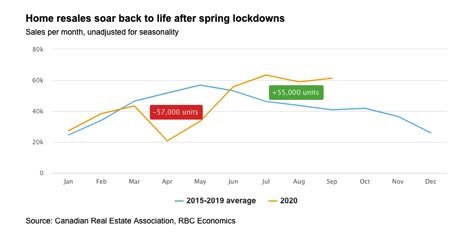
2. COVID caused the peak of real estate activity to shift from spring to summer.
From mid-March to the end of May 2020, there was a drop in real estate activity as people locked down. Despite the many negative predictions about recovery, the residential real estate market roared back to finish the year strongly.
3. Demand for rentals declined in Toronto, Montreal and Vancouver.
The decline in immigration (notably the loss of foreign students), lost wages among low income earners, and the flood of Airbnbs converted to annual rentals, created a situation where supply outpaced demand in the rental market.
4. Condo investors sold their units creating a softening of the condo market.
As demand for rentals decreased and large numbers of new condo completions brought new units to market, condo investors started to sell older units. As already noted, condo prices have dropped as a result of excess inventory on the market.
5. Real estate in smaller towns and cottage country exploded.
Remote workers concerned about urban density in the wake of COVID-19, moved out of cities to the suburbs and more rural areas, even causing a huge spike in cottage country sales activity. Muskoka, Collingwood, Haliburton and the Kawarthas all saw record activity with price increases of 30% in some areas.
6. COVID-19 helped affordability for some homebuyers.
For some qualifying buyers, homes became more affordable in 2020. Low mortgage interest rates for the forseeable future made buying more attractive. Government support programs made loss of income less of a concern in the short term. With less ability to spend money on eating out and entertainment, many buyers were able to turn the savings into downpayments.
Real Estate Market Outlook
Trends to Watch For In 2021
1. Resumption of typical buying cycles
As the results of 2020 residential home sales would suggest, it appears that market fundamentals are strong. There is demand among homebuyers for single family homes with attractive mortgage rates incenting them to buy. As buyers, sellers and realtors learn to cope with COVID protection protocols and shift towards virtual tools, it is anticipated that a more normal buying cycle will resume with the spring and fall markets being busiest.
2. “18-Hour” Canadian cities will be in demand
“18-hour” cities are defined by Investopedia as “mid-size cities with attractive amenities, higher-than-average population growth, and a lower cost of living and cost of doing business than the biggest urban areas.” (The term “18-hour” is a tongue-in-cheek way of saying cities that stay up late, but don’t party all night long.) 18-hour cities tend to attract tech workers and younger people. Typically, these cities have a vibrant downtown area with restaurants and entertainment, good transit and low crime rates. Residents are well-educated and engaged citizens.
As workers have more opportunities to work from home, migration out of 24-hour cities like Toronto, Montreal and Vancouver is expected to continue. In Ontario, examples of 18-hour cities would be Hamilton, Kitchener-Waterloo, Mississauga and Ottawa.
3. Shifts in demand and use of space
COVID has caused widespread shifts in the way we use real estate space, particularly non-residential spaces.
A. Office
With the prevalence of work from home, commercial office spaces, particularly in the downtown core, are in less demand. The jury is out as to whether or not this situation will revert once COVID is no longer such a threat.
According to a study conducted by PwC in September 2020, 34% of employees would prefer to work entirely remotely, 37% want to be in the office most of the time and 29% would like a mix of both. This suggests that, even in the long term, we might see decreased demand for office space overall, or a shift in commercial office space moving to the suburbs where greater space (to accommodate physical distancing) is more affordable.
B. Retail
Likewise, COVID has impacted on demand for big box, mall and main street retail space. Sadly, with COVID lock-down restrictions in place, businesses ranging from large chains to mom-and-pop stores have been forced to close.
In Mississauga, an effort has begun over the past few years to reimagine some of the shopping malls into mixed use spaces including residential, retail and work spaces – this trend is likely to continue.
C. Industrial
With the shift towards shopping online as a safer alternative to in-person shopping, there is a much greater need for industrial space to accommodate warehousing and fulfillment.
D. Medical
There is also the potential to re-think medical spaces. One of the lessons of COVID has been the impact the pandemic has had on medical resources. With ICU’s and hospital beds filled with COVID patients, many non-essential but nonetheless necessary medical procedures have been postponed. In future it perhaps makes sense to separate those diagnostic tests or simple medical procedures that can be done outside of a hospital to a different setting, perhaps in a retail environment, much like a dental or optometry business.
E. Home/Work/School
And lastly, with families both working and schooling at home, there is a need for less open concept, and more separate spaces within the home in order that each individual can do their thing uninterrupted.
As the need for some types of space increases and others decrease, I expect we will see some changes to the way we have typically approached commercial, industrial, retail and residential spaces.
Latest 2021 forecasts
On the basis of continued strong demand for residential housing, RE/MAX is forecasting Toronto home prices to rise up to 6% in 2021. Royal LePage is forecasting GTA home prices to rise 5.75% year-over-year with two-storey home prices to rise by 7.5%.
Selling a House During COVID
Ontario-wide shutdown
Once again the GTA is under a full shutdown to try to contain the spread of COVID-19. The lockdown took effect on December 26, 2020 and will remain in place until January 23, 2021.
While real estate is considered an essential service, there are some restrictions that must be followed:
- Real estate open houses are not permitted
- Realtors are only to conduct essential business and avoid face-to-face meetings
- Realtors are to work remotely and use technology like virtual showings, electronic signatures and virtual meetings as much as possible.
- Brokerages must screen employees and limit capacity to retain physical distancing
- Employees to wear PPE indoors and at all time when physical distancing cannot be maintained.
Virtual Staging and Photo Retouching
With the emphasis on doing everything virtually these days, I wanted to take the opportunity to talk about virtual staging and image enhancement.
When it comes to selling your property, having the home look its best is of ultimate importance. We generally use physical staging – homes that are staged sell faster and for more money – but there are some times when image enhancement or virtual staging is the better option.
Every property we sell starts with professional photography so the photos are top quality to begin with. Image enhancement can be used to adjust the white balance, straighten vertical and horizontal lines, remove small blemishes, adjust brightness or tone, and remove reflections, for example the reflection of the photographer himself in a bathroom mirror!
Did you know that photo retouching can also be used to replace a dull or cloudy sky with a blue sky, make a dry lawn appear green and tidy, and clean up the water in a swimming pool? For interior photos retouching can be used to turn on the television or light a fire in a fireplace.
One of the most popular forms of photo enhancement is the day to dusk adjustment where a daylight photo is enhanced to make it look like it was taken against a colourful, sunset sky.
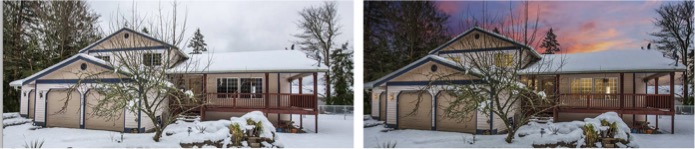
When a home is vacant, virtual staging may be a better solution than physical staging. Virtual staging essentially means re-touching furniture and décor elements into the photographs to help potential buyers visualize what the home might look like furnished. Different design styles are available in order to suit the style of home.
There is an important distinction between virtual staging and virtual renovation. Virtual staging doesn’t attempt to change the physical structure of the home, for example changing cabinets in a kitchen. Nevertheless it is essential to disclose virtual staging in the listing, to avoid disappointing buyers and possibly being accused of misrepresentation.
Speaking of misrepresentation, there was a highly publicized incident in Sydney Australia in 2016. A humongous water tower was digitally removed from a real estate photo sparking a huge outcry about misleading advertising. See for yourself.
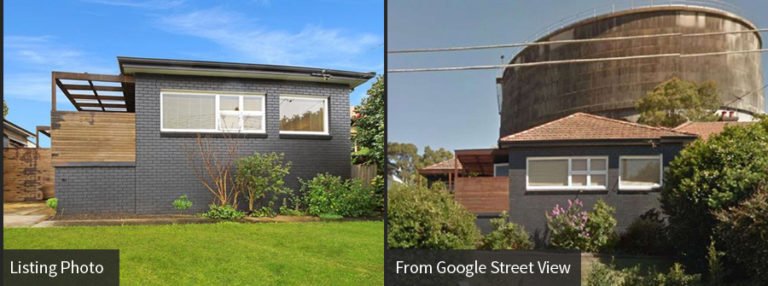
Professional real estate photography, image enhancement and virtual staging are all important tools in the seller toolkit used to make a property look its best, but care must be taken to avoid any misrepresentation. Buyer clients are disappointed when they discover a room is much smaller than it appeared to be (wide angle lens) or a home in disrepair has been made to look move-in ready. A good rule of thumb is to compare it to when a person gets dressed up – you can put on nice clothes, baubles and make up, but it doesn’t change the physical person in any way; the same should be true of virtual photo enhancements.
Help for Homeowners
COVID–19 Vaccine Roll Out
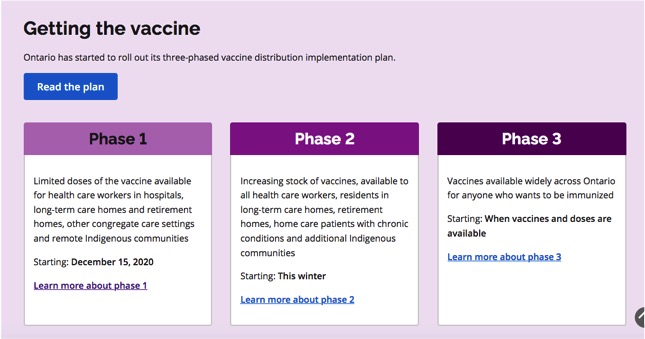
Now that both the Pfizer-BioNTech and Moderna vaccines have been approved by Health Canada, the immunization process begins.
Phase One recipients of a vaccine include residents, caregivers and staff of congregate care homes for seniors, health care workers, adults in First Nations, Metis and Inuit populations and adult recipients of chronic home health care.
As more stock of vaccine becomes available in early 2021 and more vaccination sites open up, Phase Two will begin. Phase Two recipients of a vaccine include health care workers, long-term care homes, retirement homes, public health units, other congregate care settings and remote indigenous communities.
Phase Three of the vaccine rollout is expected later in 2021 when the vaccine becomes available for the rest of the population.
That’s it for this update. If you missed any of the past COVID-19 Impact on Real Estate updates you can find them on my blog here: http://stephhebbrealestate.blogspot.com/
There is also a ton of other information there about buying or selling real estate on the blog.
Please let me know if you have any questions or feedback at Stephanie.hebb@royallepage.ca.
Stay safe.
Steph
More reading:
https://torontostoreys.com/canadian-real-estate-trends-2021/
https://torontostoreys.com/housing-market-predictions-zoocasa-2021/
https://torontostoreys.com/canada-toronto-real-estate-forecasts-2021/
https://www.livabl.com/2021/01/toronto-home-prices-2020-sales-break-record.html
https://www.livabl.com/2020/12/listings-shortage-canadian-home-prices-higher-2021.html


Comments
Post a Comment