COVID-19 Impact on Real Estate - March 15, 2021
Emailed to Clients on March 15, 2021.
Here’s this month’s update:
Real Estate Market Overview
February was another month of record-breaking home sales in the GTA. With multiple buyers competing for the available listings, double-digit annual price growth was seen throughout the GTA, with the strongest price growth in the 905.
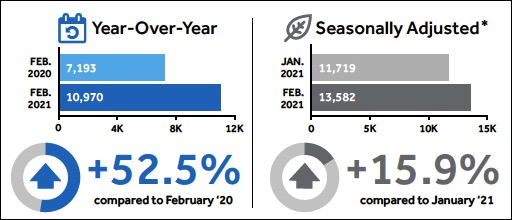
There were 10,970 sales in February 2021, up by 52.5% compared to 7,193 sales in February 2020.
Total Residential Sales
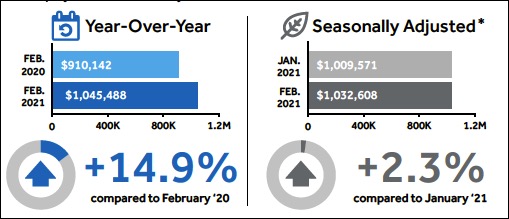
The average selling price in the GTA surpassed $1 million at $1,045,488.
Average Selling Price
Click below to watch the video highlights.

Real Estate Market Outlook
Is the bubble about to burst?
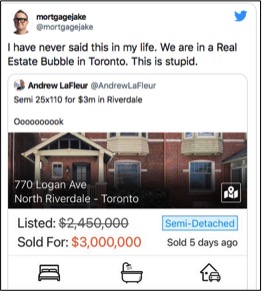
As I’ve noted in the past, some analysts have already raised concern about Toronto being in a housing bubble at risk of correction. For example, last year Swiss investment bank, UBS, said Toronto is the world’s 3rd largest real estate bubble behind German cities Munich and Frankfurt.
As home prices rise dramatically in the GTA, concerns about speculation and house flipping are being raised.
“The sort of dynamics we’re seeing could be the early signs that the market is heating up: much more frantic activity, much more fear of missing out, and accelerating prices,” says Robert Hogue, Senior Economist at RBC. “That could start to feed on itself, if speculators start to get into the game because they’re making let’s-see opportunities for quick money. But there are certainly some dynamics that are worth monitoring very closely.”
“It’s possible given the recent increases in prices, that some people are speculating about further increases in prices,” said Benjamin Tal, deputy chief economist at Canadian Imperial Bank of Commerce. “That was missing in the market until now.”
Bank of Canada Governor, Tiff Macklem has seen “early signs of excess exuberance,” and said “We are conscious that there are some risks here. We are going to have to keep an eye on this and avoid a build up of vulnerabilities.”
“Be on guard for macroprudential measures,” said Derek Holt, economist at Bank of Nova Scotia. “Ottawa has been caught completely off-guard in the magnitude of the housing response to very low financing costs.”
What is a bubble?
According to Investopedia, “a housing bubble, or real estate bubble, is a run-up in housing prices fueled by demand, speculation, and exuberant spending to the point of collapse. Housing bubbles usually start with an increase in demand, in the face of limited supply, which takes a relatively extended period to replenish and increase. Speculators pour money into the market, further driving up demand. At some point, demand decreases or stagnates at the same time supply increases, resulting in a sharp drop in prices—and the bubble bursts.”
In layman’s terms, if the bubble bursts many of the buyers who have bought during the run up will find they paid more for their home than it is worth. Add to this an increase in interest rates at some point and you have people who can no longer afford their homes.
So long, Evan
One of the noteworthy stories from the past couple of weeks was that outgoing CMHC CEO, Evan Siddall, acknowledged that the CMHC erred last May when it forecast that home prices would drop as much as 18 percent in 2020. At the time, Siddall came under fire from other industry analysts who felt the CMHC forecast was too doom and gloom.

In hindsight, we know that 2020 finished strong with sales up 12.6% for the year and average price up 17.1% compared to December 2019.
Selling a House During COVID
Danforth Village garage listed for $729,000
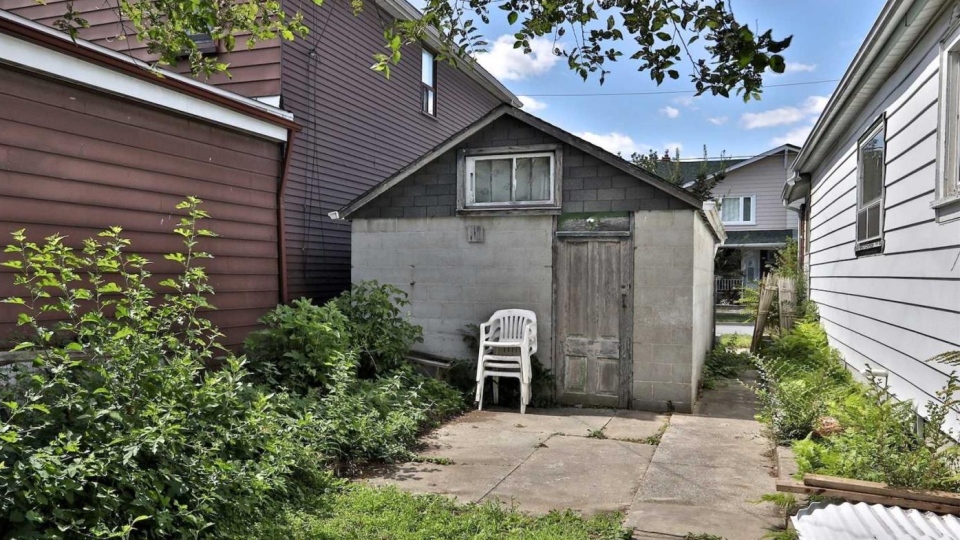
A reflection of the hot real estate market in Toronto, this property with a garage but no structure with bedrooms, bathrooms or kitchens was just listed for $729,000. At 20 feet by 100 feet and taxes of over $2600, it is being billed as a building lot – not sure how much can be built once setbacks are taken into account, but I’m sure someone will buy it and find a way.
Help for Homeowners
On February 19, 2021, The Minister of Employment, Workforce Development and Disability Inclusion announced the Government of Canada’s intent to introduce regulatory and legislative amendments to increase the number of weeks of benefits available for the Canada Recovery Benefit (CRB), the Canada Recovery Sickness Benefit (CRSB), the Canada Recovery Caregiving Benefit (CRCB) and Employment Insurance (EI) regular benefits. Click here for more information.
Phase Two of COVID-19 vaccinations
With the approval of the Janssen vaccine, and the decision to delay giving the Pfizer or Moderna booster from three weeks to four months, it appears that the vaccination timetable has taken a big step in the right direction.
On March 5, the provincial government released a list of groups who will receive a COVID-19 vaccination in the second phase. Here is the list.
Older adults
About 2.5 million people between the ages of 60 and 79 will receive their vaccines in the second phase starting with the group between 70 and 75 in early April. Individuals between 60 and 65 would receive their first doses by the end of May.
Individuals with health conditions
This consists of 442,000 people in the highest risk category with conditions such as organ transplant recipients, hematopoietic stem cell transplant recipients, people with neurological diseases in which respiratory function may be compromised, and those with haematological malignancy or kidney disease.
They will be followed by 292,000 people in the high-risk category with conditions such as obesity (BMI more than 40), those having treatments causing immunosuppression (chemotherapy, immunity-weakening medications), and those with intellectual or developmental disabilities (ex: Down Syndrome).
They will be followed by 2.2 million people in a at-risk category with conditions such as immune deficiencies, stroke/cerebrovascular disease, dementia, diabetes, liver disease, all other cancers, respiratory diseases, spleen problems, heart disease, hypertension with end organ damage, mental disorders, substance use disorders, thalassemia, pregnancy, immunocompromising health conditions, and other disabilities requiring direct support care in the community.
Congregate care settings
About 158,000 at-risk staff, essential care givers and residents of supportive housing, developmental services/intervener and supported independent living, emergency homeless shelters, other homeless populations not in shelters, mental health and addictions congregate settings, homes for special care, violence against women shelters and anti-human trafficking residences, children’s residential facilities, youth justice facilities, indigenous healing and wellness, provincial and demonstration schools, on-farm temporary foreign workers, bail beds and indigenous bail beds, and adult correctional facilities.
Essential caregivers
About 400,000 primary caregivers to individuals with the highest-risk health conditions detailed above would receive vaccines towards the end of Phase Two.
Essential workers not able to work from home
Also at the end of Phase Two about 730,000 people from the following groups: elementary/ secondary school staff, workers responding to critical events (eg. police fire, compliance, funeral, special constables, child-care and licenced foster care workers, food manufacturing workers, agriculture and farm workers.
Finally about 1.4 million people from the following groups would then follow: high-risk and critical retail workers (grocery and pharmacies), remaining manufacturing labourers, social workers (incl. youth justice), courts and justice system workers (incl. probation and parole), lower-risk retail workers (wholesalers, general goods), transportation, warehousing and distribution, energy, telecom (data and voice), water and wastewater management, financial service, waste management, and mining, oil, and gas workers.
The provincial government has said that they expect everyone in Ontario to have their first vaccine by the first day of summer. Hurray!
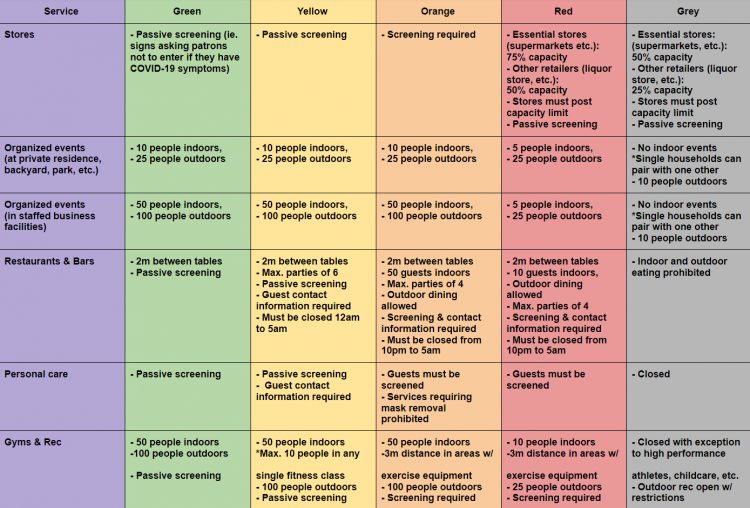
Grey-Lockdown vs. Red-Control Zones
As of March 8, Toronto and Peel regions move into the Grey-Lockdown zone, while Halton, York and Durham regions are in the Red-Control zone. For an understanding of what is open and closed, please refer to the chart below.
That’s it for this update. If you missed any of the past COVID-19 Impact on Real Estate updates you can find them on my blog here: http://stephhebbrealestate.blogspot.com/
There is also a ton of other information there about buying or selling real estate on the blog.
Please let me know if you have any questions or feedback at Stephanie.hebb@royallepage.ca.
Stay safe.
Steph
More reading:
https://financialpost.com/real-estate/when-housing-market-forecasting-goes-wrong-we-all-suffer
https://storeys.com/gta-real-estate-bubble-burst-2021/
https://storeys.com/toronto-housing-risk-health-check-rbc/
https://toronto.ctvnews.ca/dilapidated-garage-hits-the-toronto-housing-market-for-729-000-1.5332018
https://storeys.com/national-housing-markets-soaring-cmhc/
https://www.livabl.com/2021/02/bank-of-canada-monitoring-housing-market-overheating.html
https://www.livabl.com/2021/02/house-flipping-price-gains-market-trends-2021.html


Comments
Post a Comment